We Indians love our sweets. And with the festive season around the corner, our kitchens are once again filled with laddoos, halwa, payasam and other favourites.
But as we indulge in all that sweetness, it's natural to wonder if there's a better way to make our favourite treats.
That's where jaggery often enters the conversation.
Many people prefer jaggery over refined sugar because it is less processed and retains some of the nutrients naturally present in sugarcane. But does that automatically make it a better choice?
When it comes to jaggery vs sugar, the answer isn't quite that simple.
Both are sweeteners, but they differ in their processing, nutritional composition, flavour and how they behave in recipes. So, before you make the switch, let's look at what actually sets jaggery and sugar apart and which one makes more sense for your favourite Indian sweets.
Jaggery vs Sugar: What's the Difference?
Both jaggery and sugar can come from sugarcane. The difference lies largely in how they are processed.
FSSAI defines cane jaggery or gur as a product obtained by boiling or processing sugarcane juice. White sugar, on the other hand, is defined as purified and crystallised sucrose.
Jaggery is concentrated sugarcane juice that retains more of the components naturally present in the juice. Sugar undergoes further refining and crystallisation to produce the familiar white crystals.
That's why you see a difference even before you taste them. Jaggery has a golden to dark-brown colour and a distinctive caramel-like flavour. Sugar is white, neutral in flavour and consistent in texture.
Jaggery vs Sugar Nutrition: What's on the Plate?
Jaggery benefits often come up when comparing it with sugar. But what actually sets the two apart?
According to the Indian Food Composition Tables (IFCT 2017), 100 g of cane jaggery provides about 354 kcal, 84.87 g of carbohydrate, 1.85 g of protein and 0.16 g of fat. It also contains minerals including calcium and iron.
For comparison, 100 g of granulated sugar provides about 387 kcal and 99.98 g of carbohydrate, with virtually no protein or fat.
| Nutrient | Cane Jaggery | Sugar |
|---|---|---|
| Energy | 354 kcal | 387 kcal |
| Carbohydrate | 84.87 g | 99.98 g |
| Protein | 1.85 g | 0.1 g |
| Fat | 0.16 g | 0 g |
| Calcium | 107 mg | 18 mg |
| Iron | 4.63 mg | 0.15 mg |
Values per 100 g. Jaggery: ICMR-NIN Indian Food Composition Tables 2017; sugar: USDA FoodData Central. Values can vary by product.
Though jaggery contains more minerals than refined sugar, it’s still a concentrated sweetener.
FSSAI's standard for cane jaggery specifies a minimum of 90% total sugars on a dry-weight basis. So the nutritional difference doesn't mean jaggery is a free pass to use without moderation.
Jaggery vs Sugar in Indian Sweets: What Actually Changes?
Jaggery and sugar differ in more than just sweetness. They can also affect the nutrition, flavour, colour and texture of your favourite Indian sweets.
1. Jaggery Retains Some Minerals
Jaggery and sugar are not nutritionally identical. Jaggery retains small amounts of minerals such as calcium and iron because it undergoes less refining.
According to the Indian Food Composition Tables (IFCT 2017), 100 g of cane jaggery provides 107 mg of calcium and 4.63 mg of iron. But in a typical 10 g portion, that's only around 10.7 mg of calcium and 0.46 mg of iron.
So, while jaggery retains some minerals that are largely absent in refined sugar, the difference shouldn't be overstated. Jaggery is still a concentrated sweetener, with FSSAI standards requiring cane jaggery to contain at least 90% total sugars on a dry-weight basis.
2. Jaggery Brings a Deeper Flavour
Jaggery has a naturally rich, caramel-like flavour that becomes part of the dish.
That's why it works so well in traditional sweets such as:
- Til laddoo
- Chikki
- Payasam
- Pongal
- Halwa
- Modak
Sugar has a much more neutral taste. It adds sweetness without changing the flavour profile much.
So if you want the sweetener itself to contribute to the character of the dish, jaggery is a natural fit. If you want the flavours of ingredients such as cardamom, saffron, coconut or nuts to stand out, sugar may work better.
3. Jaggery Changes the Colour
This is probably the easiest difference to spot. Jaggery ranges from golden to dark brown, depending on the variety and processing. Sugar is white and much more neutral in colour.
That means the same recipe can look quite different depending on which sweetener you use.
A jaggery-based payasam, for example, will typically have a deeper colour than one made with white sugar. For traditional sweets, that golden-brown colour can be part of the appeal.
4. Jaggery Can Change the Final Texture
Jaggery contains more moisture and other naturally occurring components than refined sugar. When used in a recipe, this can affect its final consistency.
For example, a cake made with jaggery powder may turn out darker and softer than one made with sugar.
This is why replacing sugar with jaggery isn't always a straightforward swap. The result can change depending on the recipe, so it is best to use the sweetener the recipe was designed for when texture and consistency matter.
5. Jaggery Fits Traditional Indian Recipes
There's a reason jaggery has remained part of Indian cooking for generations. Its deeper flavour pairs naturally with ingredients such as sesame, peanuts, coconut, rice and spices.
Think of til laddoo, peanut chikki, sakkarai pongal or a traditional jaggery halwa. In these recipes, jaggery isn't simply there to make the dish sweet. Its flavour is part of the recipe. Jaggery powder also makes things easier in the kitchen.
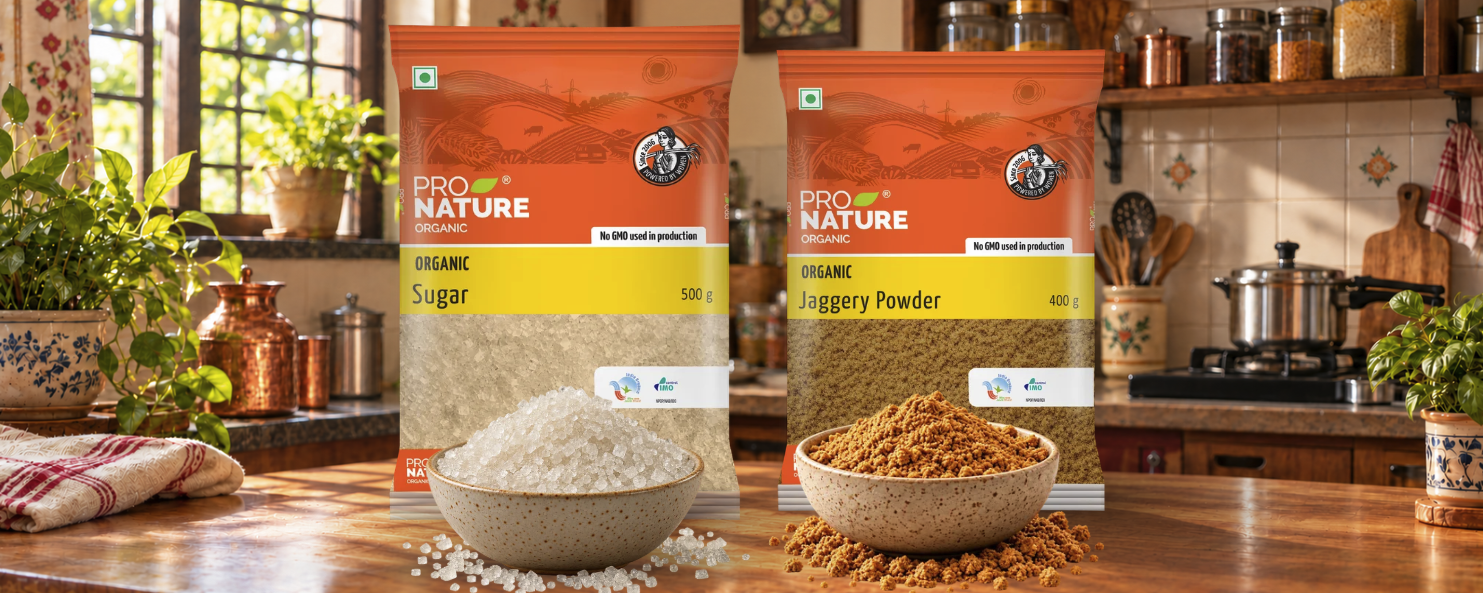
Pro Nature Organic Jaggery Powder is coarsely ground, dissolves quickly and can be used in sweets such as halwa, kheer and pongal.
6. Sugar Still Has Its Place
Sugar works particularly well when you want clean sweetness, a lighter colour and consistent texture. Many milk-based sweets, sugar syrups and delicate desserts depend on these qualities.
It's also useful when you want other ingredients to take centre stage without adding the stronger flavour of jaggery.
Can You Replace Sugar With Jaggery?
Sometimes, yes. But not always. Jaggery can replace sugar in many everyday preparations, particularly traditional Indian recipes. But because it has its own flavour, colour and moisture, the final dish may not turn out exactly the same.
Pro Nature notes that its jaggery powder can be used as a substitute for white sugar in everyday preparations, while also pointing out that it will affect the taste and appearance of the dish.
For chai, kheer, pongal and many traditional sweets, the swap is fairly straightforward. For baking or recipes where sugar's crystallisation and texture are important, a recipe developed specifically with jaggery is a better starting point.
So, Which Should You Choose?
Many people choose jaggery over sugar because it is less processed and retains small amounts of minerals such as calcium and iron that are lost during sugar refining.
But nutrition isn't the only factor. The sweetener you choose can also change the flavour, colour and texture of the final dish.
Choose jaggery when you want:
- ✓ Some naturally occurring minerals such as calcium and iron
- ✓ Deeper, caramel-like flavour
- ✓ Golden or brown colour
- ✓ A traditional taste in Indian sweets
- ✓ A sweetener that pairs well with sesame, coconut, peanuts and spices
Choose sugar when you want:
- ✓ Clean, neutral sweetness
- ✓ A lighter-coloured sweet
- ✓ More predictable texture
- ✓ Other ingredients to remain the focus
And if you're choosing jaggery powder, check more than just the label. Look at the ingredient list and, if you're buying organic, check for the relevant certification.
Why Pro Nature Organic Jaggery?
Pro Nature Organic Jaggery Powder is made from organically grown sugarcane and processed using traditional methods. It comes in 400 g and 1 kg packs, and its powdered form makes it easy to measure and dissolve.
It's suitable for everyday uses such as chai, kheer, halwa, pongal and traditional Indian sweets.
No breaking or grating a block. Just measure, add and cook.
Conclusion
Jaggery and sugar may start with the same crop, but they bring different things to the kitchen.
Jaggery has a deeper flavour, darker colour and retains naturally occurring minerals such as calcium and iron, while sugar offers neutral sweetness and more predictable behaviour in cooking.
So, when making Indian sweets, there isn't a need to pick one for everything. Making til laddoo or sakkarai pongal? Jaggery can bring the traditional flavour you're looking for. Making a delicate sweet where colour and texture need to stay consistent? Sugar may be the better fit. The best sweetener is the one that works for the recipe and your preferences.
And when jaggery is what you're reaching for, Pro Nature Organic Jaggery Powder makes it simple to bring that familiar taste of gur into your everyday kitchen.
Frequently Asked Questions
What are the benefits of jaggery compared with sugar?
Jaggery and sugar differ in their processing, composition and nutritional profile. Jaggery retains naturally occurring minerals such as calcium and iron that are present in sugarcane, while refined sugar is primarily crystallised sucrose. Both are concentrated sweeteners.
Can jaggery be used instead of sugar in Indian sweets?
Yes, jaggery can replace sugar in many Indian sweets, particularly recipes traditionally made with gur. However, it can change the colour, flavour, moisture and texture of the finished dish.
Is jaggery a type of sugar?
Jaggery is a sugarcane-based sweetener and contains a high proportion of sugars. FSSAI's cane-jaggery standard specifies a minimum of 90% total sugars on a dry-weight basis.
Does jaggery have fewer calories than sugar?
Per 100 g, the IFCT 2017 lists cane jaggery at 354 kcal, while USDA FoodData Central lists granulated sugar at 387 kcal. The exact values can vary between products.
What is the difference between jaggery powder and sugar?
Jaggery powder is finely ground jaggery, so it retains the characteristic colour and flavour of jaggery. Sugar is refined and crystallised sucrose with a more neutral taste and appearance.
Can I use jaggery powder for baking?
Yes, but it can change the colour, moisture and flavour of baked goods. For the most predictable results, use a baking recipe specifically developed with jaggery.